
Introduction
If you’ve ever wished you could build custom software faster, smoother and with fewer headaches, then you’re already thinking about the role of low-code platforms in custom software development—even if you didn’t realize it. Today, speed is strategy. Businesses want apps launched in days instead of months, and teams need flexible tools that bridge the gap between ideas and production-level systems.
Low-code platforms make this possible by empowering companies to build tailor-made digital solutions with minimal manual coding, without compromising on quality or scalability. In this blog, we’ll explore what low-code really means, why it has become a major force in custom development, and how you can use it intelligently to accelerate digital transformation.
Want help deciding if low-code fits your business? Book a consultation: https://appt.link/meet-with-chetan-chitriv-0E0czwAl/web-conference.
What It Means: Understanding Low-Code in Custom Development
Low-code platforms allow businesses to build applications using graphical interfaces, drag-and-drop elements and pre-built components instead of writing large amounts of code manually. This enables faster development cycles while still allowing custom logic, integrations and scalability.
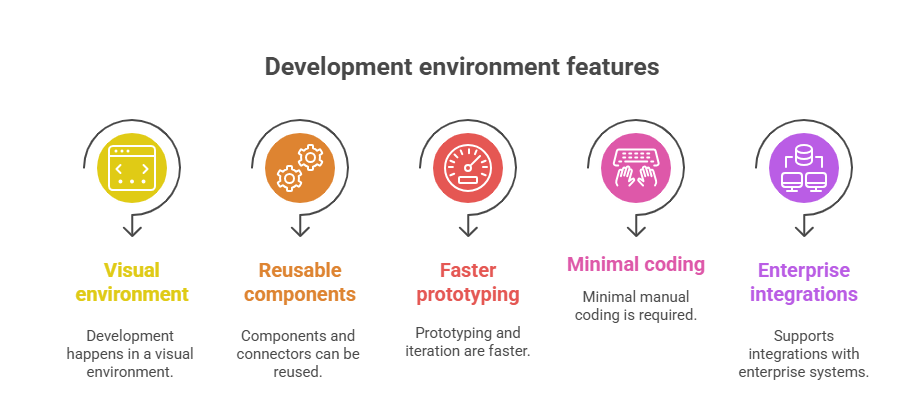
Key Characteristics
- Visual development environment
- Reusable components and connectors
- Faster prototyping and iteration
- Minimal manual coding, maximum flexibility
- Support for enterprise integrations
By blending automation with customization, low-code platforms make it easier for organizations to bring their ideas to life without sacrificing quality or performance. They offer a middle ground between traditional coding and no-code simplicity.
Why It Matters: The Growing Importance of Low-Code
Speed and agility define today’s software landscape, and low-code platforms help organizations keep up with evolving market demands. They reduce development time, lower costs and support faster innovation cycles.
Why Low-Code Is Crucial Today
- Accelerates time-to-market significantly
- Reduces dependence on large development teams
- Improves agility for product iterations
- Enables collaboration between technical and non-technical teams
As digital transformation accelerates across industries, low-code platforms offer a practical path to modernize workflows, automate processes and deploy new applications with fewer barriers.
Step-by-Step Guide: Adopting Low-Code the Right Way
Step 1: Identify Processes for Digitalization
Pinpoint workflows, internal tools or customer-facing functions that can benefit from faster development and automation.
Step 2: Choose the Right Low-Code Platform
Evaluate platforms based on scalability, integration options, security and customization capabilities.
Step 3: Start With a Pilot Project
Build a small, high-impact module first to validate speed, usability and feasibility before scaling further.
Step 4: Integrate With Existing Systems
Connect your low-code application with ERP, CRM, databases or legacy systems for seamless operations.
Step 5: Scale and Optimize
Once the foundation is tested, expand features, add automation and optimize for performance and compliance.
How Talentrise Technokrate Can Help
Talentrise Technokrate brings deep experience in custom development, low-code implementation and enterprise-grade modernization. With a balanced approach to speed and engineering precision, Talentrise helps clients harness low-code while ensuring long-term scalability.
What Talentrise Offers
- End-to-end low-code application development
- Custom integrations and workflow automation
- Modern UI/UX for business applications
- Secure and scalable architecture design
- Guidance on when to use low-code vs full-code
With Talentrise, businesses gain strategic expertise to choose the right approach—so the solution remains future-ready, secure and aligned with your unique needs.
FAQ
1. Can low-code platforms replace traditional custom development?
Not entirely. They accelerate development but some enterprise applications still require custom coding for complex logic.
2. Are low-code platforms secure enough for enterprise systems?
Yes—modern platforms comply with strict security standards and offer role-based access, encryption and audit trails.
3. Can low-code integrate with legacy systems?
Absolutely. Most platforms support connectors, APIs and custom integrations to work with existing infrastructure.
Conclusion
Low-code platforms are reshaping how businesses build software—bringing speed, creativity and agility into the development process. By blending visual design with powerful customization, they provide a smarter path to creating modern business applications. Partnering with experts like Talentrise Technokrate ensures that your low-code journey is strategic, secure and tailored to your long-term goals.
Book a consultation to explore your possibilities: https://appt.link/meet-with-chetan-chitriv-0E0czwAl/web-conference
Recommended Sites
- https://avestantechnologies.com/
- https://www.talentrisetechnokrate.com/
- https://technokrate.com/
- https://www.softwavetechify.com/
- https://chetanchitriv.in/
Here — check this out
https://talentrisetechnokrate.net/wp-admin/post.php?post=15210&action=edit